
Split AC vs Central AC in Kuwait: Which Is Better for Your Property?
Compare split AC versus central AC for Kuwait homes and offices. See how comfort, maintenance, access, and property layout affect your choice right now.
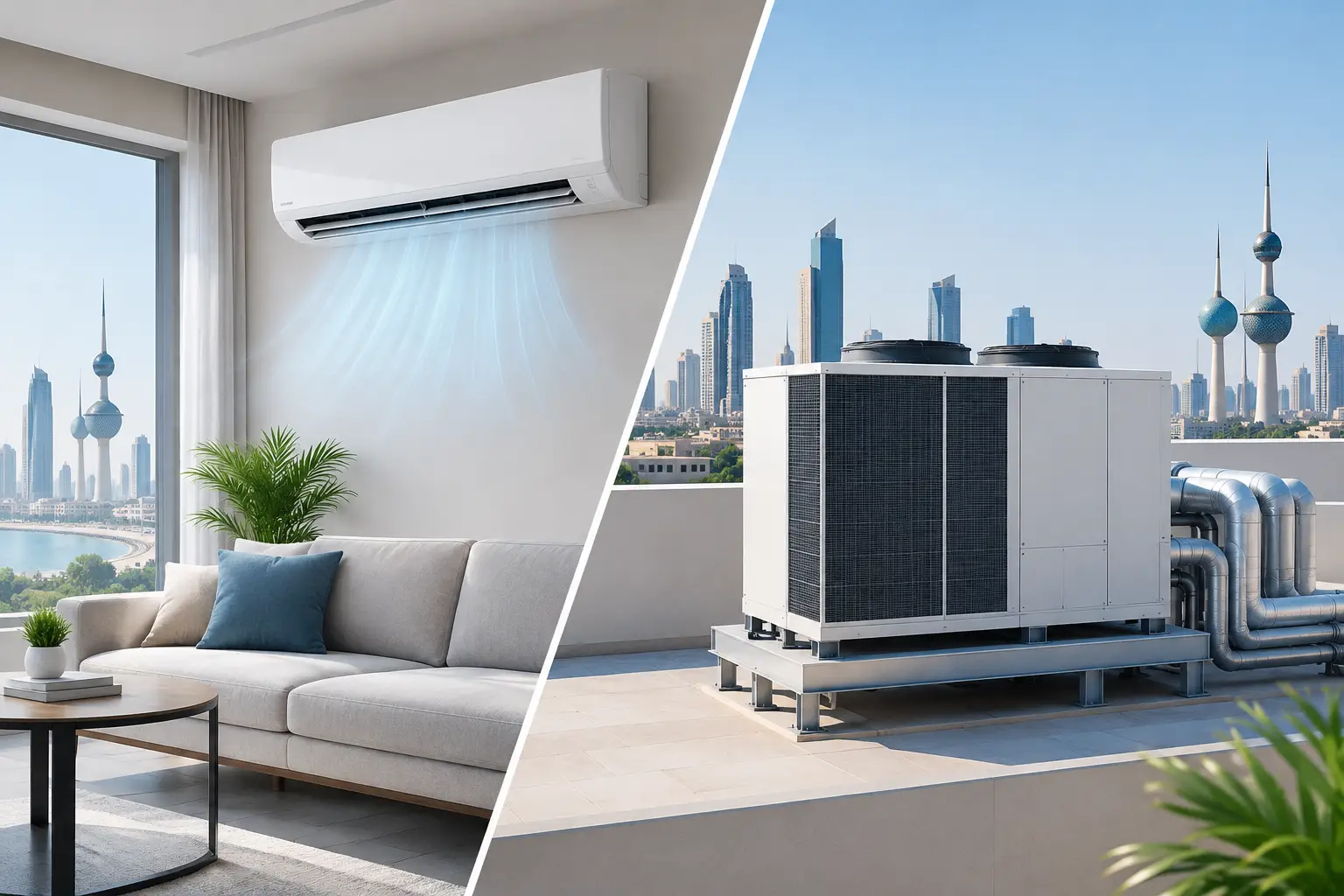
A villa with several frequently used rooms may need a different cooling setup from a small apartment, shop, or open-plan office. When comparing split AC vs central AC in Kuwait, the better option depends on the property layout, occupancy, existing infrastructure, cooling requirements, and how the system will be maintained.
Kuwait's long cooling season, high temperatures, and dusty conditions also make maintenance an important part of the decision. The question is not simply which system can make a room cold. It is which one can provide reliable cooling for the way the property is actually used.
Split AC vs Central AC: What Is the Difference?
A split AC system normally cools one room or defined area using an indoor unit connected to an outdoor condenser. Properties can have several split units, allowing bedrooms, living rooms, offices, or shop areas to be controlled separately.
A central AC system distributes conditioned air through ducts and vents from centralized cooling equipment. The exact setup can vary depending on the building, but central AC is commonly used in larger villas, offices, commercial properties, clinics, and buildings designed with ductwork.
The main difference is how cooling is distributed and controlled.
| Factor | Split AC | Central AC | |---|---|---| | Room control | Individual control for each unit | Usually centralized or zoned | | Installation | Easier to add to existing rooms | Generally needs suitable ductwork and infrastructure | | Best suited to | Apartments, individual rooms, small offices and shops | Villas, larger offices and connected spaces | | Maintenance | Multiple individual units to maintain | Central equipment, ducts, filters and controls | | Property changes | Easier to add units gradually | Changes may require duct or system assessment |
Neither option is automatically better. The right choice depends on the property.
When Split AC Is a Good Choice
Split AC in Kuwait is common in apartments, bedrooms, smaller offices, shops, extensions, and spaces that are not used at the same time.
One of its main advantages is individual room control.
For example, a family may use the living room during the day and bedrooms mainly at night. Separate split units allow each area to be operated when required without running cooling throughout the whole property.
Split AC can also be practical where installing new ductwork would be difficult or disruptive.
A property owner may use split units in:
- Bedrooms
- Apartments
- Small shops
- Individual offices
- Meeting rooms
- Property extensions
- Annexes or external rooms
However, a property with many split units also has multiple filters, drain lines, indoor units, outdoor condensers, electrical connections, and controls that need maintenance.
If six or eight units serve a villa, each one needs to be considered individually.
Common Split AC Problems
Dust buildup is particularly relevant to split AC maintenance in Kuwait.
Dirty filters can restrict airflow, while outdoor condensers need clear space for ventilation. Drainage problems can also cause water to drip from the indoor unit or create stains around walls and ceilings.
Common warning signs include:
- Weak cooling
- Reduced airflow
- Water leaking indoors
- Unusual noise
- Musty or unusual odors
- A unit switching on and off repeatedly
- One room remaining warmer than expected
Tasleeh's guide on how to choose AC servicing in Kuwait explains what information to provide when requesting professional AC support.
When Central AC Is a Good Choice
Central AC in Kuwait is often better suited to properties that need coordinated cooling across several connected rooms.
A large villa, open-plan office, clinic, retail space, or commercial property may already have ducts and central equipment designed to cool the building as one system or through separate zones.
Central AC also provides a cleaner visual appearance because conditioned air normally enters rooms through vents rather than multiple wall-mounted indoor units.
For property owners and facility managers, central cooling can work well when occupancy patterns are predictable and HVAC maintenance is managed systematically.
However, performance depends on more than the main cooling equipment.
The condition of ducts, filters, vents, thermostats, controls, drainage, and other components can all affect comfort.
Common Central AC Problems
A central system may need professional attention when:
- Several rooms are warmer than normal
- Some rooms cool while others remain warm
- Airflow from vents becomes weak
- Dust repeatedly appears around vents
- The system makes unusual noises
- Water appears near an air handler or ceiling
- The thermostat does not match room conditions
- The system repeatedly cycles on and off
Uneven cooling does not automatically mean the AC unit needs replacement. Airflow restrictions, filters, controls, duct conditions, drainage, or equipment faults can produce similar symptoms.
For offices and managed properties, Tasleeh's Commercial AC Maintenance Guide for Kuwait Buildings explains how maintenance can be organized across larger HVAC systems.
Which System Is Better for a Villa?
There is no single answer for every villa.
A large villa with existing ductwork and rooms that are regularly occupied may benefit from central AC. A property where different rooms are used at different times may benefit from the flexibility of split units.
Some villas use both.
For example, central AC may serve the main living areas while split units cool an annex, driver's room, extension, or space added after the original construction.
This type of mixed arrangement can work well, but the maintenance plan should account for both systems.
Which System Is Better for an Apartment?
Split AC is often practical for apartments because individual units can serve bedrooms and living areas independently without requiring a full ducted system.
However, the suitability still depends on the building.
Some apartment buildings already use central or building-level cooling systems. Tenants and owners should understand which parts of the AC system belong to the individual apartment and which are managed by the building before arranging major repairs or alterations.
Which System Is Better for an Office?
The decision depends on office size and layout.
A small office with a few separate rooms may operate effectively with split AC units.
A larger workplace with open areas, meeting rooms, reception spaces, and many occupants may benefit from central or ducted AC, particularly when the building was designed around that system.
Operating hours also matter.
An office running throughout the day has different cooling and maintenance requirements from a meeting room or storage area that is only used occasionally.
What About Energy Use?
The AC type alone does not determine energy use.
System capacity, installation quality, thermostat settings, insulation, occupancy, room exposure, equipment condition, airflow, and maintenance all influence how hard the system needs to work.
Independent split units can be practical where only selected rooms need cooling.
Central systems can be suitable where large connected spaces need consistent cooling, particularly when effective zoning and controls are available.
Rather than choosing only on claims about efficiency, assess how the property will actually use the system.
Maintenance Matters for Both Systems
Both split and central AC need regular maintenance in Kuwait.
For split units, this may include filters, drainage, coils, indoor units, and outdoor condensers.
Central AC maintenance may also involve ducts, vents, air handlers, thermostats, controls, drainage, and larger equipment.
Filter condition is particularly important in dusty environments. Tasleeh's guide on HVAC filter replacement schedules explains why frequency should be based on usage, dust exposure, occupancy, and system type.
Drainage also deserves attention. Blocked condensate lines can lead to leaks, ceiling damage, and unpleasant odors. Read more about why AC drain lines need regular cleaning.
Repair or Replace the Existing AC?
An older AC system does not automatically need replacement.
Weak cooling, water leakage, unusual noise, or uneven temperatures should first be properly diagnosed.
The condition of the equipment, repair history, availability of parts, recurring faults, system performance, and whether the existing setup still suits the property should all be considered.
Tasleeh's AC replacement comparison for Kuwait properties explains the factors to consider before deciding between another repair and replacing the system.
Frequently Asked Questions
Is split AC better than central AC in Kuwait?
It depends on the property. Split AC can be practical when rooms need independent control, while central AC can suit larger connected spaces with suitable ductwork and infrastructure.
Which AC is better for a villa in Kuwait?
Large villas designed with ducts may benefit from central AC, while villas with rooms used at different times may benefit from split units. Some properties use a combination of both.
Which AC system is easier to maintain?
Split systems involve multiple individual units, while central systems involve larger equipment, ducts, vents, controls, and drainage. Neither is maintenance-free. The workload depends on the number of units, system design, operating hours, and condition.
Can I replace central AC with split AC?
It may be possible in some properties, but this is a system-design decision rather than a simple equipment replacement. Room layout, electrical capacity, outdoor-unit locations, drainage, cooling load, and building rules should be assessed first.
Request AC Repair and HVAC Maintenance in Kuwait
If your AC is cooling poorly, leaking water, making unusual noise, or leaving some rooms warmer than others, the first step should be an assessment of the existing system.
Tasleeh provides AC Repair & HVAC Maintenance in Kuwait for homes, villas, offices, and managed properties. Support includes fault inspection, repair coordination, and preventive maintenance for residential and commercial cooling systems.
When submitting a request, provide the property type, AC system type, affected rooms, symptoms, and any available access information.
Whether the property uses split AC, central AC, or a combination of both, a clear assessment helps determine the correct maintenance or repair scope before equipment changes are considered.