
Managed Versus In-House Building Maintenance
Compare managed versus in-house building maintenance for Kuwait properties, including cost control, accountability, service scope, and daily operations.
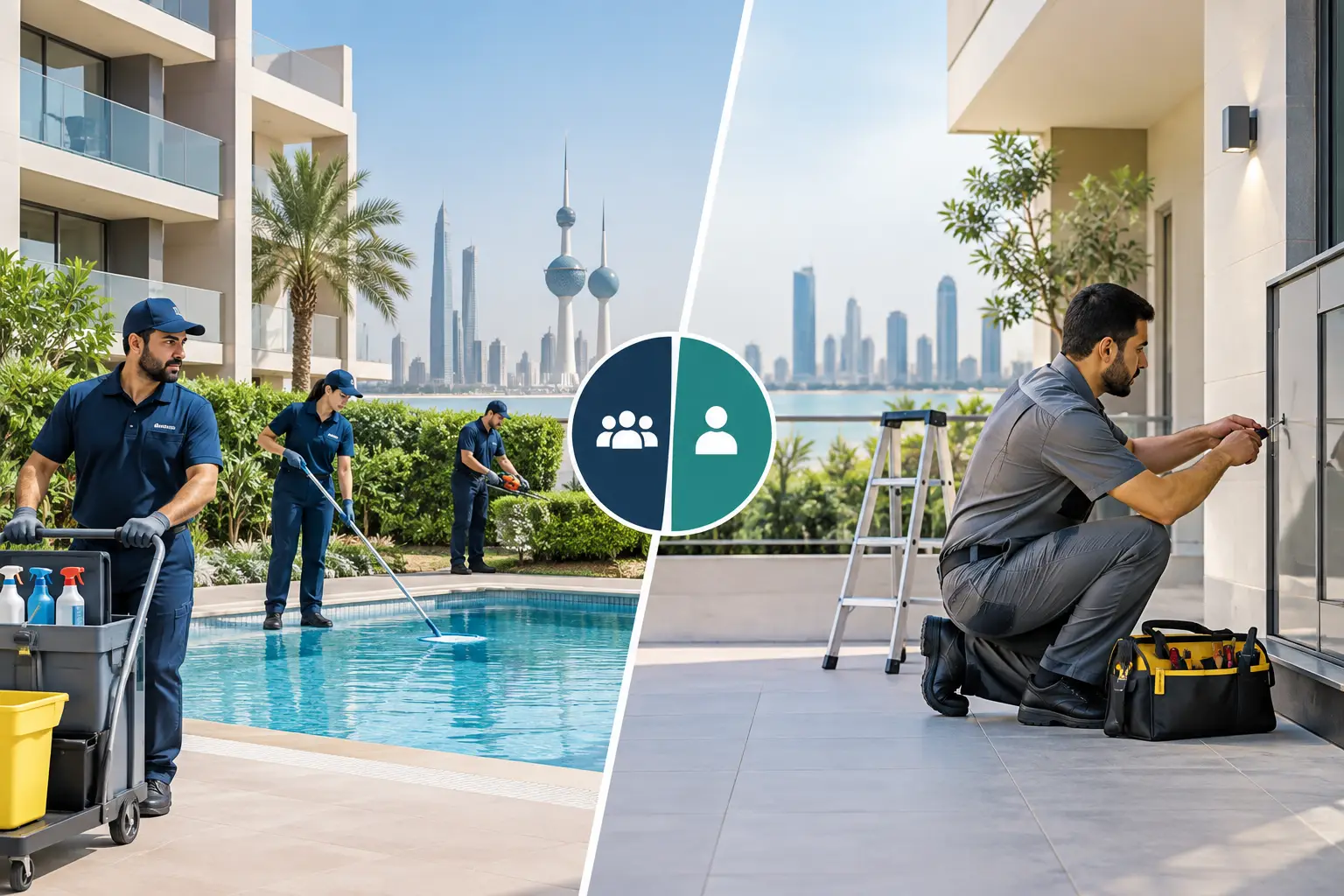
A failed AC unit in a tenant's apartment, a blocked drain in an office restroom, or repeated electrical faults in a shop all create the same question for the person responsible for the property: should maintenance be handled by an internal team or by a managed provider? Managed versus in-house building maintenance is mainly a decision about control, accountability, workload, and the type of systems your property needs maintained.
For many properties in Kuwait, a managed model is more practical when maintenance needs change from week to week or require several technical specialties. An in-house team can make sense for larger sites with constant, predictable work and sufficient management support. The better option is the one that gives occupants a clear way to report problems and gives the owner confidence that essential work is being followed through.
Managed Versus In-House Building Maintenance: The Key Difference
In-house maintenance means the property owner, landlord, or facilities department employs and supervises its own technicians. The business is responsible for hiring, scheduling, tools, parts coordination, training, leave coverage, and daily task assignment. This approach can provide close familiarity with one site, especially where there are frequent routine tasks.
Managed maintenance places service delivery and coordination with an external provider. The provider receives requests, clarifies the scope, arranges the relevant team, communicates updates, and follows up on the work. Rather than building an internal maintenance department, the customer works with a defined service operation.
Neither model is automatically right for every villa, residential building, office, or commercial property. The practical choice depends on what can fail, how often work is needed, and who will be accountable for keeping service requests from being lost between tenants, security, management, and technicians.
When an In-House Team Can Be the Better Fit
An internal team is often worth considering when a large property has a steady volume of basic, repeatable maintenance work every day. A major residential complex, a large office site, or a property portfolio with a dedicated facilities function may benefit from technicians who know the equipment rooms, access procedures, tenant patterns, and recurring issues.
The advantage is immediate familiarity. An on-site team may notice a dripping pipe, damaged switch, or AC performance issue during its normal rounds before a resident formally raises a request. It can also coordinate small operational tasks alongside planned checks when that falls within the team's responsibilities.
However, an in-house arrangement needs more than technicians. Someone must prioritize jobs, check completed work, control parts purchases, document recurring faults, and cover absences. A small internal team can be stretched quickly when several AC calls arrive during Kuwait's hottest months, or when urgent plumbing and electrical issues occur at the same time.
Specialist coverage is another consideration. One or two general maintenance employees may not be the right resource for every HVAC, plumbing, or electrical fault. Property managers should be realistic about where their team has a clear scope and where external technical support is still required.
Why Managed Maintenance Suits Many Properties
A managed provider is useful when the property needs organized service without the overhead of supervising a permanent technical department. The owner or manager can report a fault, provide access details, and have the request directed to the appropriate service scope. This is particularly helpful for landlords who manage occupied apartments, office managers focused on business operations, and building managers handling multiple tenant requests.
For essential MEP Maintenance Services Kuwait properties rely on, clear coordination matters as much as the repair itself. An AC complaint may involve a cooling issue, an electrical supply concern, or a drainage problem. A managed operation can collect the initial details and arrange the appropriate technical response instead of asking the customer to identify the fault alone.
Tasleeh Core delivers HVAC and AC repair and maintenance, plumbing, and electrical maintenance through its own managed operations. This can suit individual repair requests, planned preventive maintenance, and maintenance contracts where customers need defined communication and follow-up for critical building systems.
Managed maintenance also helps create consistency across requests. The provider can record the reported issue, arrange the visit, and communicate around access or scheduling. That does not mean every issue has the same repair or timeline. A fault may require inspection, parts, owner approval, or coordination with building management. It does mean the request has a clearer path than an informal call to whichever technician happens to be available.
Consider the Real Cost, Not Only Payroll
Comparing monthly salaries with a service invoice is not a complete comparison. An in-house model also involves recruitment, supervision, equipment, supplies, storage, replacement coverage, and the management time needed to keep work organized. These costs may be justified at a high-volume site, but they should be visible in the decision.
Managed service costs are easier to associate with specific requests, maintenance visits, or contract scopes. The trade-off is that the provider needs accurate information to plan the work properly. A vague request such as "AC not working" may need further details about the room, the number of affected units, access restrictions, and whether the issue is affecting one tenant or an entire area.
For a mixed-use building, it may be sensible to avoid treating every service under one model. Essential HVAC, plumbing, and electrical systems may need a managed technical operation, while separate specialist services are arranged as needed. This is not a weakness in the plan. It is often a more accurate reflection of the skills required.
Use the Right Model for Specialist Services
Building maintenance extends beyond MEP systems. Cleaning, deep cleaning, pest control, swimming pool cleaning and maintenance, laundry, shutter services, car washing and detailing, and car maintenance each have distinct scopes and workflows.
Tasleeh Network manages customer requests and delivery workflows for these specialist services through approved partner providers. This differs from claiming that every service is performed by the same internal team. For a customer, the value is having a clear request process and organized communication while the work is delivered by the relevant approved provider.
A building manager should separate routine cleaning needs from a technical repair request. An office cleaning visit, for example, should identify the areas involved, preferred timing, security procedures, and whether work must happen outside business hours. Pool cleaning and maintenance should include details about pool access, current concerns, and any site rules. Clear scope helps prevent the common problem of arranging a visit without agreeing on what the visit is meant to cover.
Questions to Ask Before Choosing a Model
Start with the pattern of work, not the label. How many maintenance requests does the property receive in a typical month? Are they mostly routine tasks, or are they technical AC repair, plumber, and electrical maintenance calls? Does the property have someone who can manage an internal team daily and verify completed jobs?
Then consider the consequence of poor coordination. In an occupied building, an unresolved water leak can affect another unit. In an office, weak cooling can disrupt staff and visitors. In retail or commercial space, electrical faults may interfere with normal operations. Properties with multiple tenants and restricted access often benefit from a managed process because someone must coordinate keys, security clearance, parking, work permits where required, and tenant notifications.
Finally, look at seasonality. Kuwait's heat and dust place significant demand on AC systems, while busy occupancy periods can increase plumbing and cleaning requirements. If your internal team is quiet for part of the year but overloaded during peak periods, a fully in-house structure may not be the most efficient fit.
Prepare a Better Maintenance Request
Whether you use an internal team or a managed provider, useful information speeds up the initial assessment. Share the property type, exact location of the issue, what you have observed, when it started, and whether the problem affects one room or several areas. For an AC issue, mention whether the unit is not cooling, leaking water, making unusual noise, or showing an error indication. For plumbing, explain whether the concern is a blocked drain, leak, low water flow, or fixture problem.
Also confirm who can provide access. In apartments and offices, the person requesting work may not be the person holding keys or authorized to approve it. Tell the service team about tenant schedules, building security requirements, parking limitations, and any need to coordinate with the landlord or facilities manager.
Do not attempt electrical repairs, open AC equipment, or dismantle plumbing connections to investigate the problem. You can safely document visible symptoms and keep the affected area accessible, but diagnosis and repair should be left to the appropriate professionals.
A maintenance model should make life easier for the people responsible for the property, not create another layer of chasing calls and approvals. If you need help with AC, plumbing, electrical maintenance, or an approved specialist service, submit a clear service request with the property details and access information so the right scope can be arranged.